M4 Master BundesEcho Bringing visibility to the political echo.

Team

  • Zaynab
  • Merveille
  • Konstantin
  • Zidanie
  • Sonja

Supervision

Bruno Schilling

Research & Conception

Research
We started with a review of academic work on political data visualization and civic tech to ground the project in established practices. In parallel, we evaluated the abgeordnetenwatch.de API to assess data structure, coverage, and long-term viability.

Conception
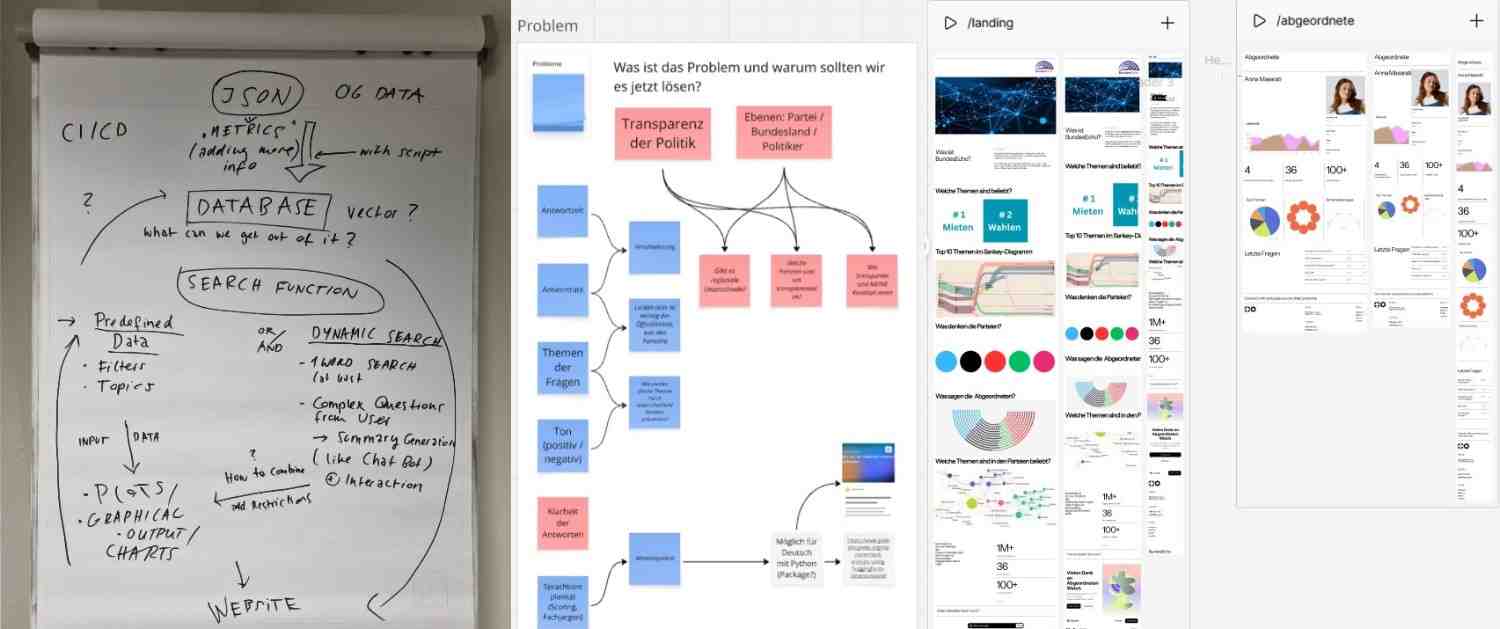
Insights from research fed into collaborative ideation sessions. Using Miro, we mapped user goals and exploration paths, tested different interaction concepts, and translated them into low-fidelity sketches that defined the initial direction of the platform.

Pictures from brainstorming sessions, Miro and Figma
Project development from ideation to Figma prototype

Implementation Strategy

Scope & Data Access
The platform was designed as a German-language web application, aligned with the source data. To balance depth, performance, and data quality, we limited the scope to the 20th legislative period of the Bundestag. With permission from abgeordnetenwatch.de, a dedicated data collection workflow was implemented.

Information Architecture
To support exploration without overload, we introduced a three-layer Funnel Architecture:

  1. High-level overviews of political activity
  2. Comparative views across parties and topics
  3. Detailed profiles of individual representatives

This structure guided both navigation and technical design.

Data Structuring
Unstructured political text was transformed into structured, interpretable representations to support analysis. Instead of simplistic labels, we focused on dimensions that reflect political context and communication patterns. Detailed analytics are documented separately.

Design Process
Design evolved iteratively from sketches to a high-fidelity Figma prototype. The visual language balances institutional credibility with an exploratory interaction style, prioritizing clarity and usability over visual novelty.
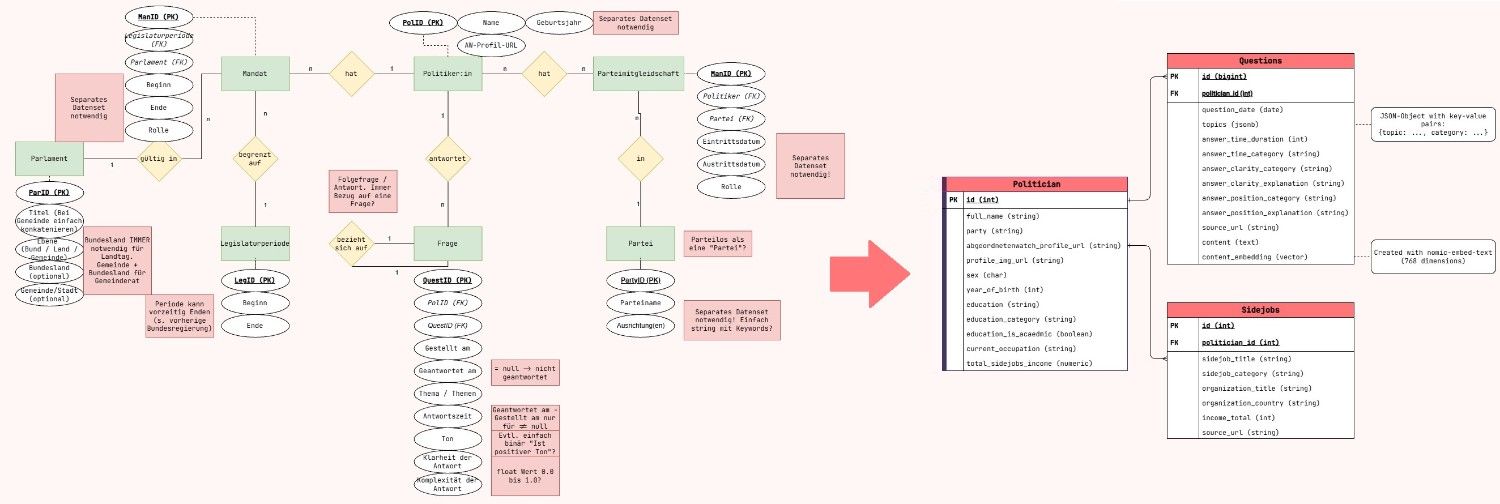
Scope changes over time as ERM diagrams
Evolution of project scope over time

Development & Deployment

Workflow
Development followed an agile approach with weekly sprints and regular in-person reviews at HTW. A pull-request workflow with peer review ensured code quality and shared responsibility.

System Architecture
Backend and frontend were developed in parallel with a focus on modularity and reusable components. Clear interfaces enabled fast iteration and laid the groundwork for future extensions.

Deployment
The final system was deployed using a production-grade server setup, ensuring stable performance under concurrent use and marking the transition from prototype to public application.

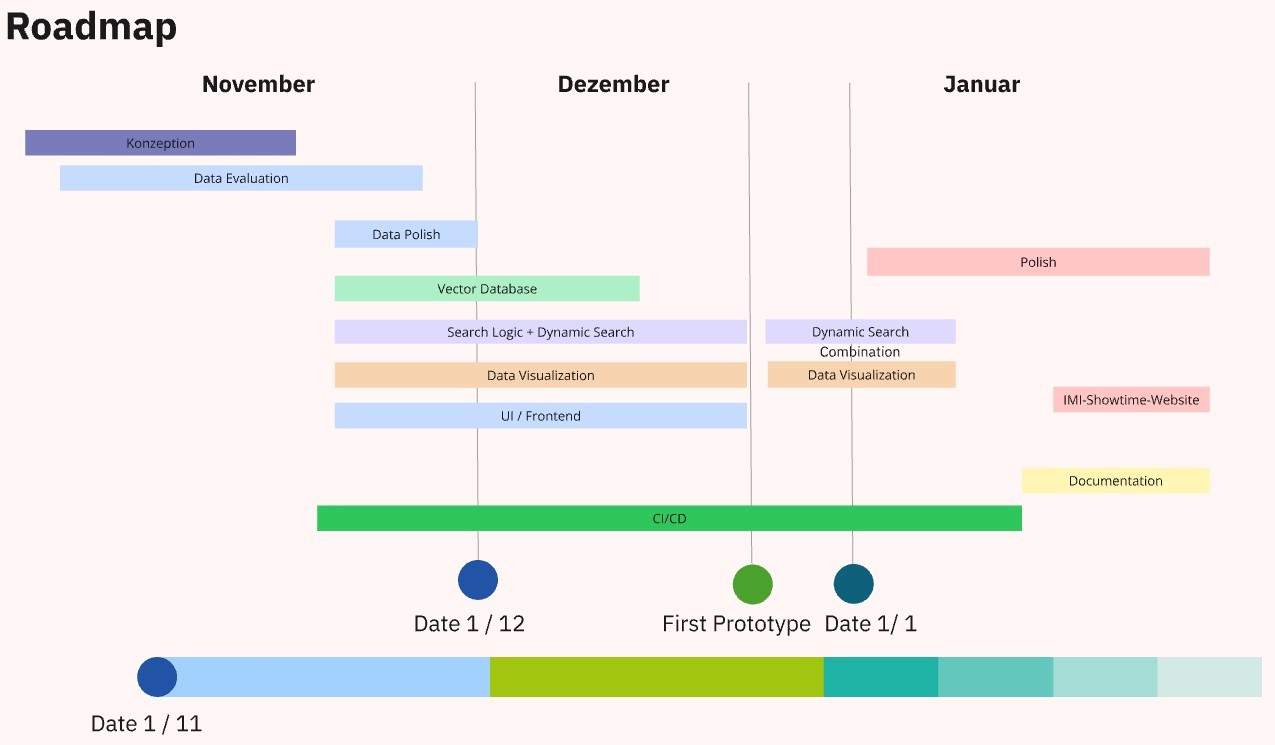
Roadmap
Project roadmap and milestone planning

Challenges & Solutions

Scope Control
Processing the full multi-parliament archive proved unrealistic. Restricting the scope to the current Bundestag improved performance and result quality.

Context Sensitivity
Short political statements lose meaning when analyzed in isolation. We addressed this by preserving contextual information throughout the processing pipeline.

Efficiency
Limited resources required careful technical choices. Iterative testing helped balance computational efficiency with analytical reliability.

Transparency
To build trust in automated analysis, interpretability was treated as a core requirement. Outputs are designed to remain understandable and assessable by users.