M4 Master BundesEcho Bringing visibility to the political echo.

Team

  • Zaynab
  • Merveille
  • Konstantin
  • Zidanie
  • Sonja

Supervision

Bruno Schilling

When thousands of political Q&As blur the big picture, BundesEcho reveals the patterns behind them. Don’t just read — explore positions, rhetoric, and trends with AI-powered insights.

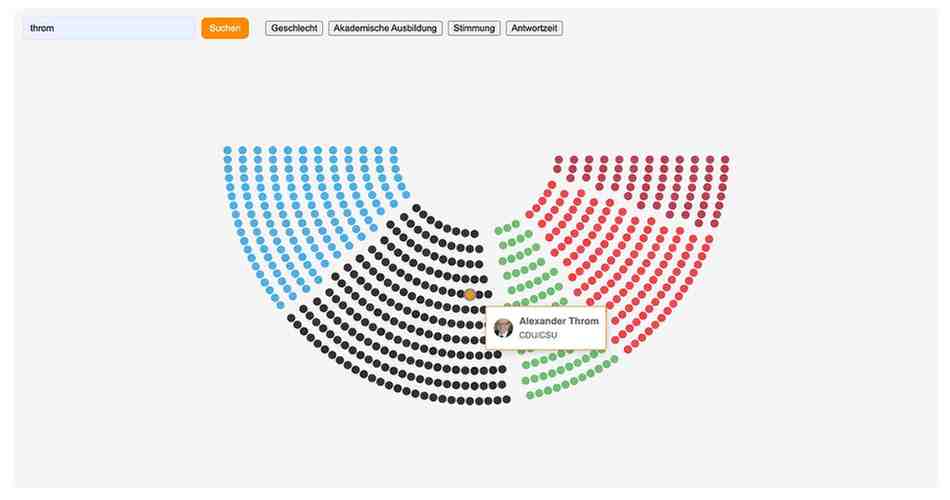
Parliament diagram on BundesEcho
Screenshot from BundesEcho

Our Goal

Problem

German federal politics is complex. With the Bundestag comprising 630 representatives, it is difficult for citizens to track political positions, communication behavior, and responsiveness at scale. As a result, meaningful insights are often limited to individual politicians rather than broader political patterns.

Source

Since 2004, the NGO AbgeordnetenWatch has addressed this challenge by enabling direct questions and answers between citizens and elected representatives. While the platform provides valuable transparency on a case-by-case basis, it is primarily designed for reading individual exchanges and does not support systematic analysis across politicians, parties, or time.

Goal

The Q&A archive of abgeordnetenwatch.de contains valuable insights that go beyond individual politicians. By applying NLP techniques, BundesEcho uncovers systemic patterns in political communication, such as sentiment, topic focus, and response behavior—enabling a data-driven comparison of parties and representatives.

Process and Outcome

Concept & Scope
Drawing on concepts from our Visualization course, we designed an interactive analysis platform. To balance depth, performance, and data quality, we focused on the current legislative period of the Bundestag—an approach reflected in the name BundesEcho.

Implementation
Development followed an iterative, user-centered process, beginning with Figma prototypes. The frontend uses Angular and Apache ECharts to present complex political data through responsive, interactive visualizations.

The backend is built with Django and combines classical data querying with a local Retrieval-Augmented Generation (RAG) pipeline. PostgreSQL with pgvector stores semantic embeddings, while locally hosted language models enable context-aware retrieval beyond keyword search.

Despite challenges in data modeling and operating a resource-intensive AI backend, the team’s combined expertise in frontend development, backend architecture, and data science resulted in a fully functional platform.

Outcome
BundesEcho enables exploration of political communication patterns over time, including positioning, topic focus, and responsiveness across politicians, parties, and categories. Traditional filters are complemented by semantic search and AI-supported summaries, helping users efficiently identify trends and recurring dynamics in the data.

Team

BundesEcho began with a joint research and concept phase, ensuring a shared understanding of goals and constraints. During implementation, the team split into two specialized units while maintaining close collaboration.

Frontend Team

  • UI/UX design
  • Interactive data visualizations
  • Client-side application development

Backend Team

  • Server and deployment setup
  • Database architecture and data modeling
  • API design and ETL pipelines
  • Integration of locally hosted language models

We also thank Darius B. for designing the Showtime poster and HTW Berlin for providing access to machine learning infrastructure.

Team behind BundesEcho
Beautiful team behind BundesEcho