M4 Master BundesEcho Bringing visibility to the political echo.

Team

  • Zaynab Ammar
  • Merveille Kinfack Nguetsa
  • Konstantin Kuklin
  • Zidanie Noudeng Mazamo
  • Sonja Anna Sartys

Supervision

Bruno Schilling

BundesEcho Tech Stack

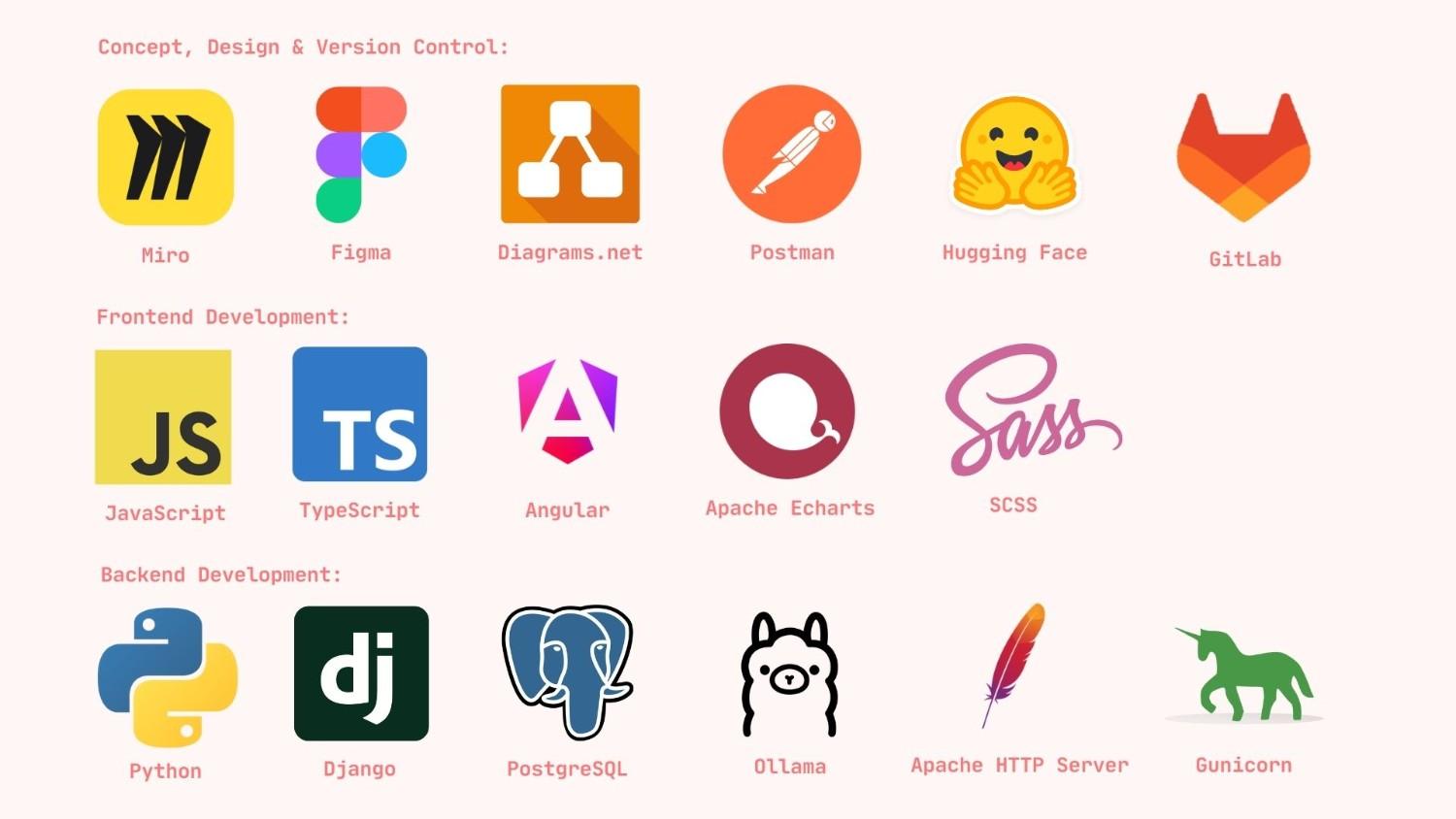
Concept, Design & Version Control

Miro
Miro was used for the initial brainstorming sessions. It allowed the team to collaboratively visualize ideas and document key decisions.

Figma
Figma was used to create the UI component library, the style guide, and the final high-fidelity design of the BundesEcho user interface.

Diagrams.net
We utilized this tool to design the entity-relationship diagram for the database schema.

Postman
Postman served as our primary tool for testing and debugging APIs while the backend server and database were under development.

Huggingface
Huggingface was used for research and tests of various NLP models for the augmentation of the Q&A archive and RAG.

GitLab
GitLab served as the central platform for version control, hosting our frontend and backend repositories. We utilized its integrated Kanban board to manage tickets, assign tasks, and track development progress.

Frontend Development

JavaScript
JavaScript is the fundamental scripting language used to drive interactivity and logic throughout the frontend application.

TypeScript
TypeScript is a typed superset of JavaScript that ensures code reliability. We used its static typing and tooling to maintain a scalable codebase and prevent runtime errors.

Angular
Angular was our chosen component-based framework. It handles the single-page application (SPA) architecture, routing, and state management for a seamless user experience.

Apache ECharts
ECharts is the engine behind our data visualizations. We implemented Sankey diagrams, Gauge charts, Pie charts, network Graphs, and PictorialBars to make complex political data digestible.

SCSS
SCSSis an extension of CSS that allowed us to use variables, nesting, and mixins, ensuring a consistent and modular design system across the platform.

Backend Development

Python
Pythonwas used for all backend logic, data processing pipelines, and AI integration.

Django
Django was our web framework of choice. It provides the REST API structure, manages the database, and serves as the bridge between the client and our AI services. PostgreSQL with pgvector extension
PostgreSQL combined with the pgvector extension was selected to store and query high-dimensional embeddings for semantic search.

Ollama
Ollama-client, hosted on the HTW ML server, served our local LLMs, handling inference for augmentation and summarization.

Llama 3.1 (70B)
This is the state-of-the-art LLM used for data augmentation and RAG summarization. We selected the 70B parameter model for its superior nuance in understanding political context.

nomic-embed-text-v1.5
This is a high-performance embedding model that converts Q&A text into 768-dimensional vectors. This model was selected for its high accuracy and speed, enabling efficient semantic search and vector-based similarity analysis.

Apache HTTP Server
Apache is the configured backend server used to host the BundesEcho backend application.

Gunicorn
Gunicorn serves as our WSGI application server, managing Django worker processes and handling HTTP requests forwarded by Apache for the application.