Wasteland Courier is a VR cycling game that combines physical cycling with an interactive game world.
Instead of using a traditional controller, the player controls the game by riding a real bicycle mounted on a bike trainer. Pedaling, steering, and physical effort are directly translated into the virtual environment.
It is set in a zombie apocalypse where a small group of survivors lives isolated on an island. Since motorized vehicles are no longer available, bicycles have become the only means of transportation. As a newly appointed courier, the player is responsible for securing supply routes and delivering essential goods across the island.
Therefore, you assemble your bike, determine which goods to load, and then … YOU RIDE. Ride faster than the zombies, or otherwise you will become one of them.
Our Goal
Motivation
Cycling outdoors is engaging and motivating, but training conditions are not always ideal due to weather, time constraints, or safety concerns. As a result, many cyclists train indoors using bike trainers. While these devices provide accurate performance data, the training experience itself is often repetitive and visually unengaging.
Goals
The goal of this project was to make indoor cycling more engaging by embedding physical training into a meaningful and immersive game experience.
We aimed to:
Gamify indoor cycling without abstracting away physical effort
Use real-world training data as direct game input
Increase motivation through narrative context and gameplay challenges
Create a strong sense of immersion using virtual reality
The player should feel like they are actively riding a bicycle in another world, rather than simply exercising in front of a screen.
Process
The project started with a game design phase in which we explored different approaches to combining cycling and gameplay. Early concepts were sketched and discussed using collaborative tools, focusing on motivation, physical interaction, and immersion.
We then developed a series of technical prototypes to validate our ideas:
Initial Unity VR prototypes
Reading and interpreting bike trainer data
Sending resistance and gradient information back to the trainer
Testing gyroscope-based steering using a smartphone
These prototypes helped us refine both the gameplay and the technical setup before integrating everything into a cohesive game experience.
Outcome
We developed a VR game called Wasteland Courier using Unity. The game is controlled entirely through a real bike trainer and mobile phone gyro sensors, translating physical input directly into gameplay mechanics.
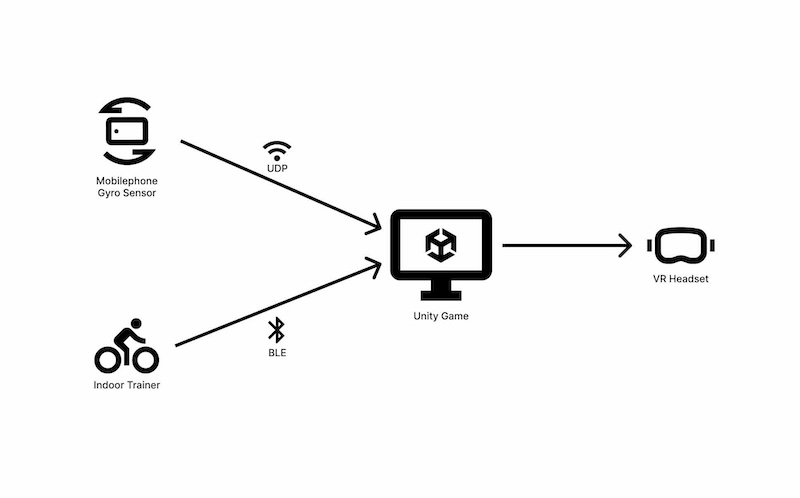
The bike trainer communicates with the game via Bluetooth Low Energy (BLE). Therefore, we implemented a BLE Connector in Unity that supports the Fitness Machine Service (FTMS) specification. Using this service, our game can receive live performance data such as power output (watts), as well as send back resistance data to the trainer, to simulate inclines and terrain.
To enable steering, a smartphone is mounted on the handlebar and used as a gyroscope sensor. The smartphone sends gyroscope data via UDP to synchronize real-world steering with the in-game bicycle handlebar.
This setup allows the game to react dynamically to the player’s physical performance and creates a direct link between effort and gameplay.
System Architecture
Gameplay and Features
In Wasteland Courier, the player prepares for each mission in a garage before entering the world:
Garage Phase
Before each tour, the player prepares in the garage. The bicycle can be assembled and customized by equipping different parts that affect both appearance and gameplay. New components are unlocked through progression and can be equipped to adapt the bike to different challenges. The player also chooses which goods to transport, balancing risk and reward, and selects a route to ride.
Route Phase
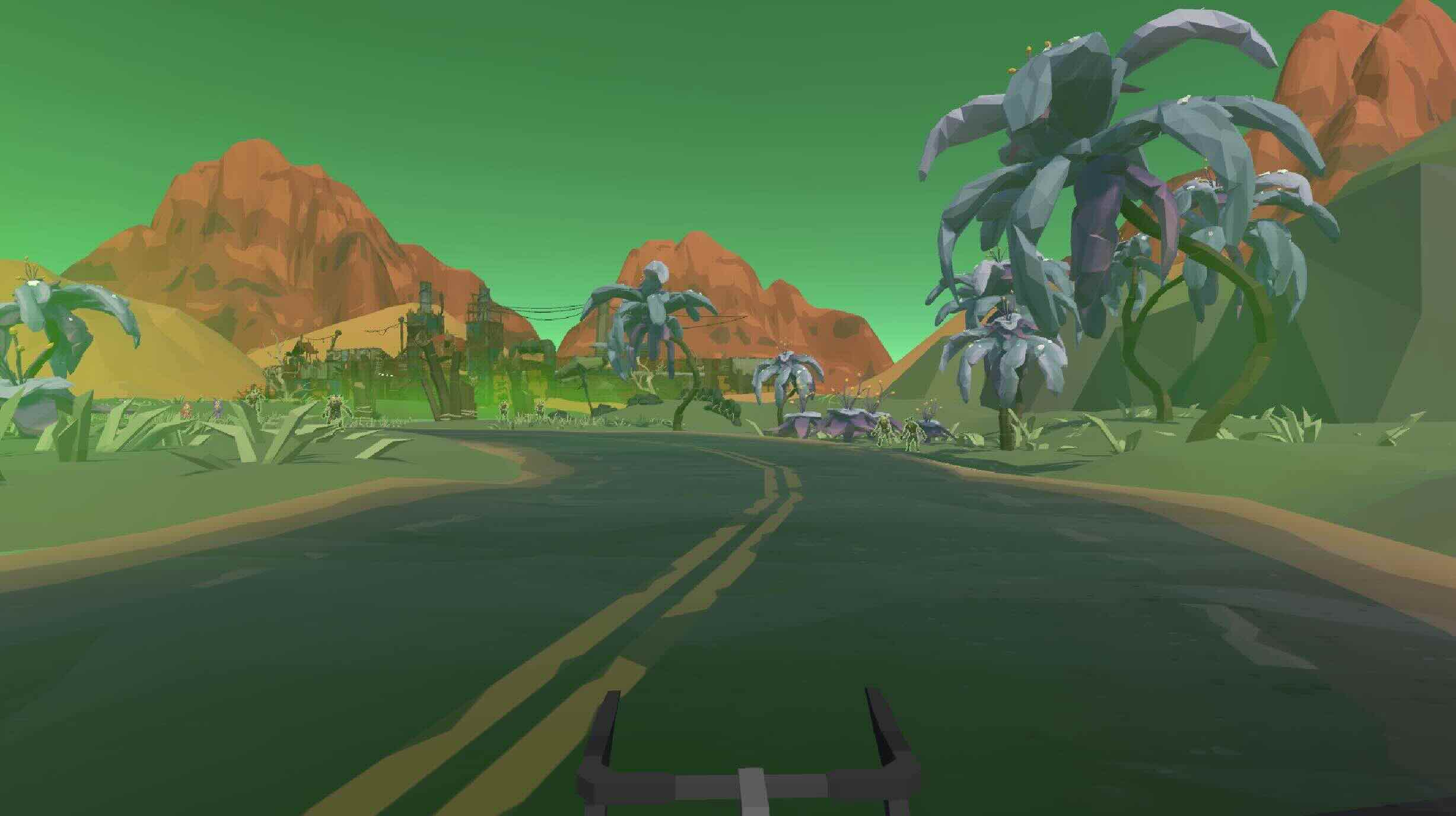
During the route, the player rides through the environment using a real bicycle mounted on a trainer. Pedaling controls speed, while steering is handled through the handlebar. Along the way, the player must avoid zombies and environmental obstacles while discovering items placed along the route. The goal is to reach the destination as efficiently as possible, as stopping or slowing down increases the risk of being caught.
We designed two routes with different difficulty levels:
A beginner-friendly 1 km swamp route
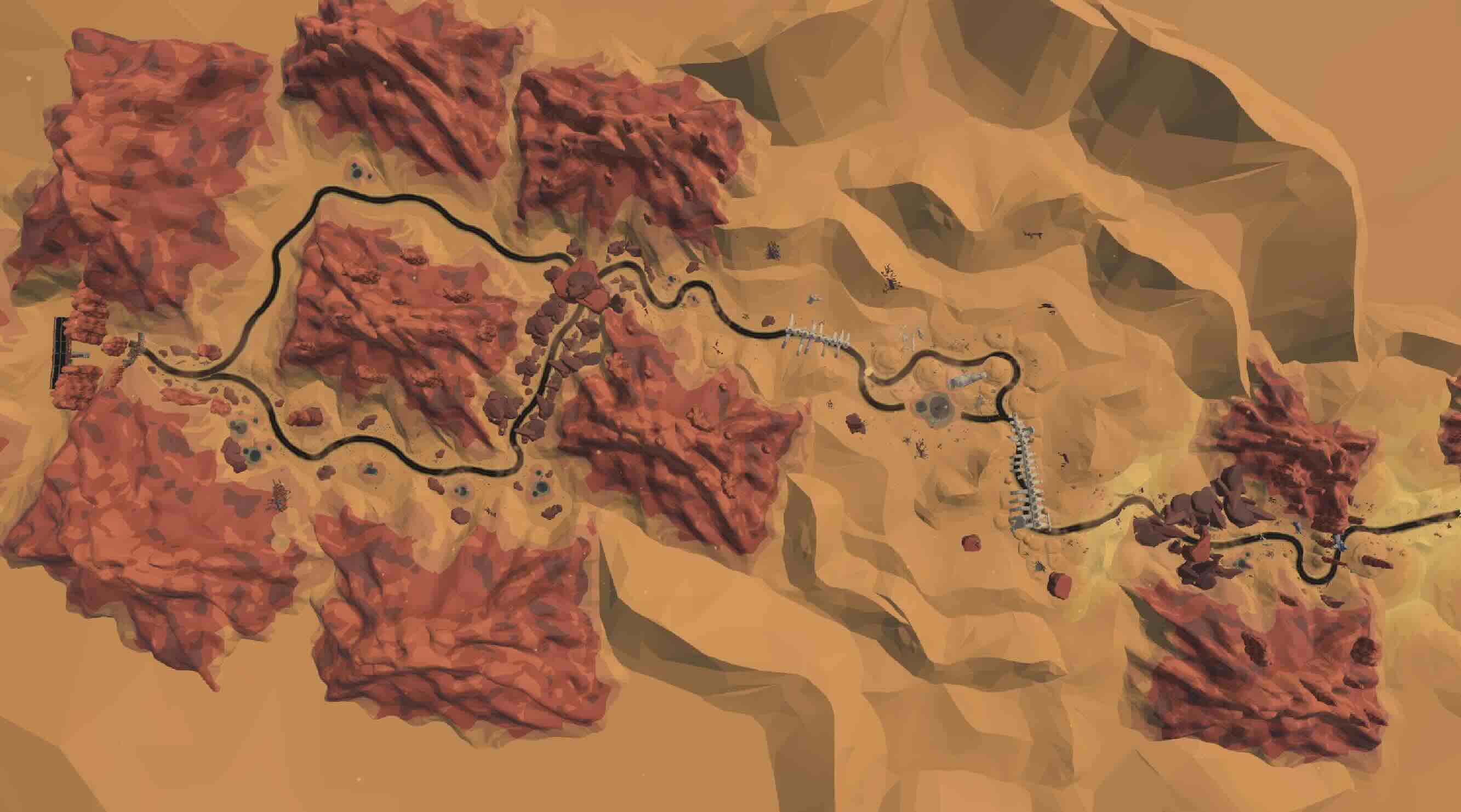
A more challenging 5 km desert route
Both routes are designed to encourage physical effort and create an immersive world while maintaining a clear gameplay goal.
In addition to the technical implementation, we designed and built a coherent game world that supports immersion and storytelling. Custom assets were created specifically for the bicycle and its components to ensure consistency between real-world interaction and virtual representation.
Swamp Route, 1km longDesert Route, 5km long
Team
Oliver HirthMarvin PetschFelix KühneMatthis EhrhardtDavid Brenn